


By Precious Orunduyi & Ifeoluwa Adeyeye
The Centre for Storytelling and Development Initiative (CSDI), on 13 September 2025, concluded its 12-week Storytelling for Development Programme 2025.
The virtual graduation ceremony held on Saturday marked the end of the programme, which began on June 21, 2025.
Of the 62 participants who started the programme, only 38 were deemed worthy of graduation after they completed the requirements for the award of a certificate of completion.
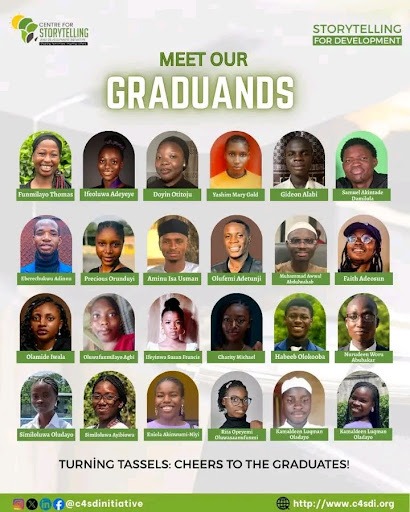
CSDI Storytelling for Development Programme’s Graduands 2025
Addressing the graduands on the theme, “Telling Your Own Story”, Mrs Bosede Akinbolusere, a Gender Equality and Women Empowerment trainer at the African Leadership University, USA, said storytellers should start with telling their personal story before others’ stories, to build trust and connection with the audience.
She lamented that Nigerians and Africans, as a whole, often do not tell their own stories, urging the CSDI’s graduands to start changing the narrative.
She added that authenticity, consistency, and creativity are key to an excellent storytelling career. She advised the graduates to utilise visuals, leverage technology, and stay rooted in their niche to make a lasting impact.
“Learn to always tell your own story, no matter how small it is. How will the world believe the stories you’re telling, if you can’t tell your own story? Create an online presence and let it reflect your niche,” Akinbolusere said.
The graduation ceremony continued with the presentation of certificates to the graduates.
As part of the programme, awards were given to five graduands in five different categories.
Similoluwa Ayibiowu emerged as the Overall Active Trainee; Olamide Iwala was declared the winner of the Best Engaging Short Video.
Oludayo Similoluwa won the Best Engaging Short Article; Ifeyinwa Francis topped the Most Active Forum Contributor, while William Olaleye pitched the Best Story Idea.
Also present at the ceremony are the CSDI’s Board of Trustees, including Mr Lawal Dahiru, Mrs Jemimah David-Makeri, Mrs Precious Oluwole and Mr Anthony Okoboshi.
One of the programme team, Miss Rukayat Fatia, in her vote of thanks, applauded the graduands’ dedication and the efforts of each training moderator.
She further appreciated CSDI Founder, Mr Saheed Ibrahim, whose vision had created a platform where young people can find their voices in storytelling.
The programme was designed to equip young people with the skills and knowledge needed to tell impactful stories that drive development.
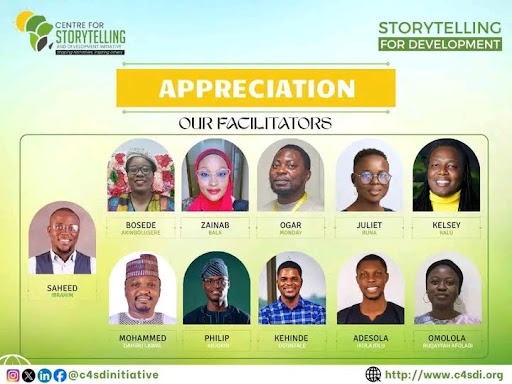
Training facilitators
It covered a wide range of topics, starting with “The Art of Storytelling” in Week 1, where participants learned the fundamentals of storytelling and its importance in development.
In Week 2, “What Makes a Better Story”, participants discovered the key elements that make a story compelling. The programme then went into more specific topics, such as “Storytelling for/about Marginalised Community” in Week 3, where participants learned how to tell stories that amplify the voices of marginalised communities.
The training also covered “Solutions Journalism” in Week 4, teaching participants how to focus on solutions rather than problems in their storytelling. Additionally, participants learned about “Reporting Vulnerable Groups” in Week 5 and “Digital Storytelling” in Week 6, where they discovered how to leverage digital tools to tell impactful stories.
In Week 7, “Telling African Stories Better”, participants learned how to tell stories that showcase African perspectives and experiences.
In the latter part of the programme, participants learned about “Data Journalism/Storytelling” and “Fact-checking and OSINT Skills in Storytelling” in Weeks 8 and 9, respectively.
These sessions equipped participants with the skills needed to work with data and ensure the accuracy of their stories.
The programme concluded with “Legal, Ethical and Safety Considerations in Storytelling” in Week 10, and “Pitching Story Ideas” in Week 11, where participants learned how to effectively pitch their story ideas to editors, audiences and stakeholders.