

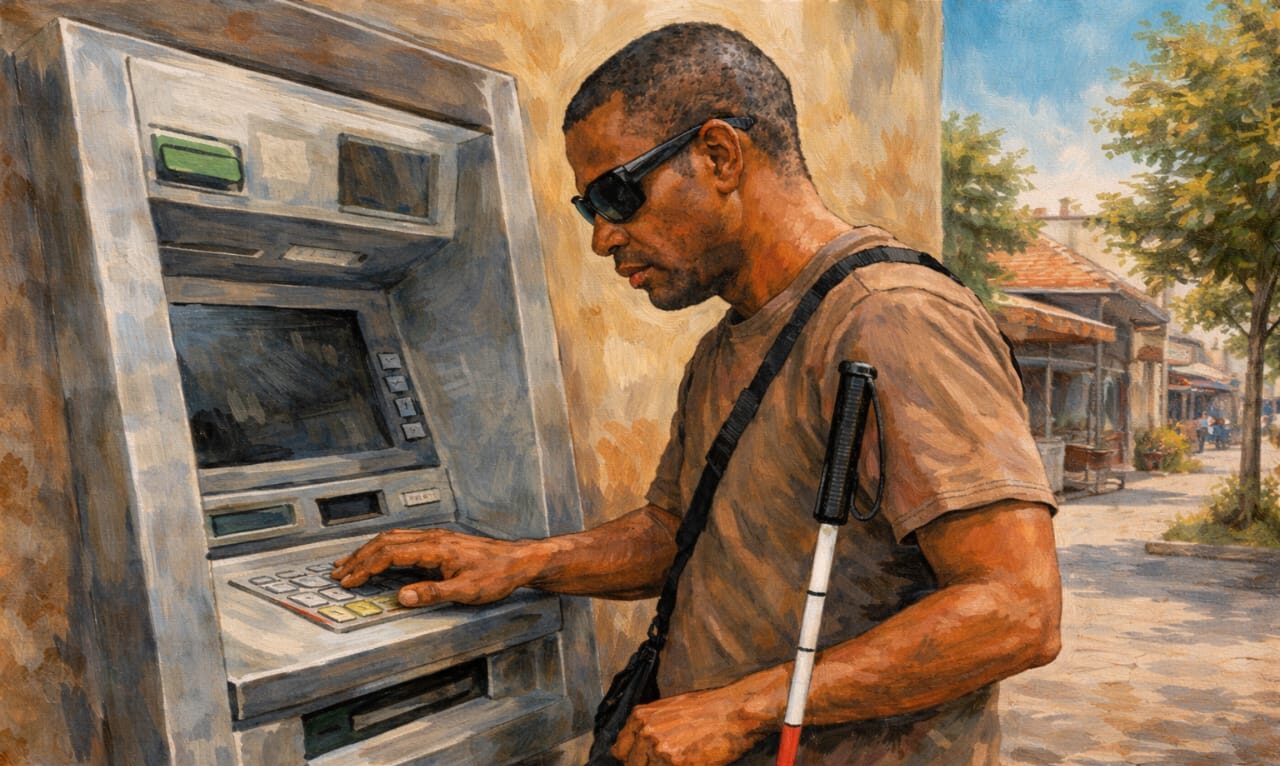
- Despite CBN’s accessibility rule issued in 2010, most ATMs still lack features that enable independent use.
- Some banks require visually impaired customers to sign indemnity forms before issuing ATM cards.
By Emmanuel Oluwadola
Born with visual impairment, Azeez Olajumoke, stood quietly in a queue to withdraw cash at a Wema bank in Ekiti State, southwest Nigeria.
As her turn to use the automated teller machine (ATM) got closer, Olajumoke’s unhappiness surfaced, not for her disability or the lack of an ATM card, but for one thing: “The ATMs are not user-friendly to people with visual impairment,” she said, as her voice reflected a weary frustration from years of exclusion.
“When you know you cannot use the ATM, why did you come?”
For many Nigerians, using the ATM is a routine, two-minute task. But for Olajumoke, an attempt to use the ATM was a moment to trade her privacy for assistance. Due to a lack of features such as functional headphone jacks, screen readers, braille markers or tactile graphic symbols, she is forced to disclose her most sensitive personal identification number (PIN) to whoever happens to be standing next to her.
“If I want to use the ATM, I always talk to someone in the queue, either in front of me or behind me, to assist me,” she said.
“I would beg them, ‘Sir or Ma, when you are done, please, can you help me use the ATM card?”
Her request for assistance often received mixed responses, ranging from compassion to cruelty, from other sighted users. While some offer a helping hand, others offer criticism.
“Some will say things like: ‘When you know you cannot use the ATM, why did you come?’ ‘Why can’t you come with someone?’”
She recalled a painful moment when she approached a bank security guard for help, hoping for a professional and safe transaction.
“He (bank security guard) told me, ‘I can’t help you because if anything goes wrong, I don’t want to be held responsible, so go and look for someone else,’” she recounted.
Defrauded!!!
In 2018, Olajumoke was scammed after seeking help from a stranger at the ATM.
“I asked someone to help me use the ATM, and the person scammed me. The person withdrew all of my money. Everything. It was when I went to the bank to complain that I was asked to get a police report before I could be given the footage of who did that,” she bemoaned.
Olajumoke’s struggle highlights a massive gap in Nigeria’s push for financial inclusion. While the Central Bank of Nigeria (CBN) continues to advocate for a cashless economy, the recent surge in ATM withdrawals nationwide leaves a significant portion of the visually impaired population behind.
The Nigeria National Blindness and Visual Impairment Survey estimated that 4.25 million adults, aged 40 and above, in Nigeria are visually impaired or blind. Recently, research revealed that 24 million Nigerians have sight loss.

Isma’il Bilyaminu. Photo Credit: Isma’il
Isma’il Bilyaminu, a visually impaired person based in Kaduna State, on Saturday, around 10 a.m., visited a GTBank ATM at Muritala Square in Kaduna, hoping to withdraw cash. Unfortunately for him, no individual was at the ATM to help.
“I tried my best to see if I could access the machine, but unfortunately, I couldn’t. I spent more than an hour before somebody came. Then I asked for his assistance.
“Unfortunately, he exchanged my card for his card, thinking I had a lot of money there. Thank God I didn’t have much in the account then,” he said.
Upon getting home, Bilyaminu discovered that his ATM card had been swapped.
“The following day, I quickly went to the bank to complain. The bank blocked my account and then gave me another ATM card. The manager even advised me not to use the ATM, but rather to come directly to the counter for assistance and guidance. He also refunded the money stolen from my account,” he narrated.
A similar case of ATM fraud involving a visually impaired customer was reported in 2024, when an unnamed woman allegedly swapped a visually impaired widow’s ATM card and withdrew over N2 million from her account.
According to the reports, the incident occurred after the widow asked the suspect for assistance at an ATM stand in Nnewi, in Nnewi North Local Government Area of Anambra State. The theft was later uncovered from the bank’s CCTV footage after the victim reported receiving multiple debit alerts.
A visually impaired bank customer in Anambra State, Somadina Chukwueloka, also mentioned that his visually impaired neighbour was defrauded after begging a stranger to assist him in using an ATM.
“The person took his card and asked him how much he wanted to withdraw from the ATM. Instead of withdrawing the amount the blind guy told him to withdraw, the person withdrew more than the amount,” he explained.
According to Somadina, unfortunately for the individual, the visually impaired neighbour quickly checked the debit alert on his phone and discovered that the individual had withdrawn more than he was asked to.
When confronted, the individual returned the excess amount and claimed he thought a higher sum had been requested.
Privacy Lost, Doubled Costs
The lack of independent access does not just cost visually impaired Nigerians their dignity; it imposes a tangible financial penalty on their disability.
Somadina added that the lack of accessible ATMs effectively forces him to pay more for basic banking services.
He explained that a trip that would cost a sighted person about N2,000 often costs him N4,000 because he must cover the transport fare for a sighted person who accompanies him to the ATM.
He asserted that withdrawing cash over the counter also incurs fees for withdrawal slips, which sometimes compels him to limit the amount he withdraws, as accessing larger sums would require paying for multiple slips.

Somadina Chukwueloka. Photo Credit: Somadina
“I have first-hand experience at a First Bank; you can’t withdraw more than N10,000 with the withdrawal slip, and for every withdrawal slip, you pay N50. Imagine I want to withdraw N100,000. That means I’m going for 10 withdrawal slips, which would cost me N500.
“And there are transactions I may not be able to carry out because someone is assisting me to do it,” he added.
Somadina stressed that using an ATM in Nigeria has been impossible for the visually impaired without significant assistance.
He recounted that he and a friend had to visit a specific ATM multiple times to memorise the button locations.
Somadina’s primary concern, however, remains the total erosion of privacy.
He emphasised that no matter how close a trusted companion may be, the loss of privacy exposes him or any visually impaired person to financial risks and fraud.
16 Years Later, CBN’s 2% ATM Policy Out of Reality
In April 2010, CBN released the Standards and Guidelines on Automated Teller Machine (ATM) Operations in Nigeria. Section 2 (f) of the policy explicitly states that:
“2% of ATMs deployed shall have tactile graphic symbol for the use of visually impaired customers. This should be complied with within five years from the release of these standards.”
However, more than 15 years have passed since the policy was introduced, and about 10 years have passed since the compliance deadline.
Despite the penalties outlined in the policy, which state that “sanctions, in the form of monetary penalties and/or suspension of the acquiring/processing service(s), or both, would be imposed on erring institutions for failure to comply…,” the number of fully accessible ATMs in Nigeria remains extremely low.
In practical terms, most machines are not equipped with functional headphone jacks, screen readers, Braille markers or tactile graphic symbols that would enable visually impaired persons to use them independently.
Legally, Nigeria’s Discrimination Against Persons with Disabilities (Prohibition) Act 2018 prohibits discrimination on the basis of disability. Sections 3 to 5 of the Act mandate that public buildings, including banks, must be accessible to visually impaired customers, with non-compliant corporate bodies liable for fines of N1,000,000.
In 2024, the federal government, through the National Commission for Persons with Disabilities (NCPWD), warned financial institutions that violations could attract sanctions. NCPWD Executive Secretary, Ayuba Gufwan, highlighted that visually impaired customers often fall victim to fraud when forced to rely on third parties to access ATMs, and promised penalties for banks that fail to provide an enabling environment.
Despite these laws and repeated government warnings, there is no publicly available data showing that any bank has been sanctioned or prosecuted under the Act, leaving visually impaired Nigerians largely without safe and independent access to banking facilities.

Challenges visually impaired persons face while using ATMs. Graphics designed by Emmanuel Oluwadola
However, the Centre for Infrastructural and Technological Advancement for the Blind (CITAB) criticised the CBN ATM accessibility guidelines, stressing that the apex bank has failed to implement an inclusive plan for persons with disabilities (PWDs) in Nigeria.
According to the organisation’s Executive Chairman, Jolomi George Fenemigho, essential accessibility features remain largely absent. He noted that audio guidance, Braille instructions and universally accessible controls continue to be overlooked. He also argued that the guidelines are vague about what genuine inclusion entails and offer no clear pathway to ensure ATMs are accessible to all users.
For many visually impaired Nigerians, the situation remains unchanged. Aki Emmanuel, the State Youth Leader of the Nigerian Association of the Blind in Cross River State, said the CBN’s 2 per cent ATM accessibility policy has not improved the ability of blind users to operate machines independently.
He recounted an experience with a screen-glass ATM in his state. After attempting to use the touchpad, he realised the machine had no screen reader to provide audio guidance or directional feedback, leaving him unable to complete the transaction without assistance.

Aki Emmanuel. Photo Credit: Aki
The simple act of withdrawing cash at the ATM has become a burden, forcing him into a dangerous compromise of dependency.
“I see it as a difficult task.”
He said he once had to rely on a sighted person to use an ATM, noting that seeking assistance from strangers at banks can be risky for visually impaired individuals.
He added that while some people show empathy, others react negatively or question why he did not come with someone to guide him, which makes it difficult to rely on public assistance for ATM transactions.
POS: Risky Option
The failure of commercial banks to make ATMs accessible to visually impaired persons has forced many of them to rely on point-of-sale (POS) terminals, which also have inherent shortcomings.
Nasirudeen Oladele, Public Relations Officer of the National Association of the Blind (Ondo State Chapter), said that resorting to POS terminals does not guarantee absolute privacy.
“Most times, I don’t make use of my ATM card. If the POS terminal has keypads, I can still use it. But if it is a screen touch, I will have to tell them (POS attendants) my ATM PIN. But most times, I usually transfer the money to them (POS attendants),” he said.
ATM Card and the Indemnity Form Trap
The barriers Olajumoke and other visually impaired customers face are not only social but also institutional. Olajumoke revealed that a particular bank in Ekiti refuses to issue ATM cards to visually impaired customers unless they go through a rigorous and legal process.
“If they must give a visually impaired person an ATM card, such a person must collect a form and go to court, then sign an undertaking that if anything happens, the user should be held accountable,” she said.
Somadina also attested to this particular challenge, stating that visually impaired customers are required to sign an indemnity form, shifting liability completely from the bank to the visually impaired person requesting the ATM card.
He claimed that most Nigerian banks used to deny persons with visual impairment access to ATM cards, knowing that most ATMs are not inclusively accessible.
“In case of any fraudulent activities, the bank will bring out the two signed forms — the ATM card request form and the other extra indemnity form that the visually impaired person is forced to sign,” he claimed.
Somadina recalled the discrimination he experienced while trying to obtain an ATM card at a local bank in his state.
He said, “I visited the bank once to request an ATM card, and a whole branch manager opened his mouth to tell me, ‘What is a blind person doing with an ATM card? No oh! We don’t allow such things here.’ I took the matter up and made him know that it is my right to own an ATM card.
“After the whole thing, he told the people at the customer service to give me the ATM card without the indemnity form,” he said.
Stanley also explained how he visited a UBA bank to collect an ATM card, “they (the bank) told me to go and get an affidavit from the court before they could issue me an ATM. I was very mad at them.”
While there are glimmers of hope for inclusion – from UBA’s unveiling of a braille account-opening form in 2023 for the visually impaired, to First Bank’s plans to introduce braille statements and voice-assisted ATMs. These steps remain isolated practices rather than industry standards.
Failed Response from CBN and Nigerian Commercial Banks
To ensure accurate reporting, the journalist contacted several Nigerian commercial banks, including First Bank, United Bank for Africa (UBA), Access Bank, Zenith Bank, Guaranty Trust Bank (GTBank), and First City Monument Bank (FCMB).
On 17 February 2026, emails were sent to the official addresses listed on the banks’ websites requesting details on their efforts over the past decade to comply with the CBN’s 2% ATM accessibility mandate. The queries specifically asked for:
- The number of ATMs equipped with functional headphone jacks, screen readers, Braille markers, or tactile graphic symbols.
- Official positions on requiring visually impaired customers to sign indemnity forms waiving their consumer protection rights as a condition for obtaining ATM cards.
- Challenges faced in installing ATMs accessible to visually impaired customers.
Despite these requests, there has been no substantive response from the banks.

A sample copy of a Nigerian bank indemnity form for visually impaired persons. Document Source: BONews, first published by Equality Reporters
Some of the banks, including Zenith, FCMB, FirstBank and UBA, acknowledged receipt of the email, assuring that a review will follow and a response will be provided within 24 to 48 working hours.
The journalist contacted GTBank Customer Support via WhatsApp to inquire, but the response was vague and a bot-generated reply that did not address the inquiry.

Screenshot of the response on the GTBank Customer Support channel on WhatsApp. Photo Credit: Emmanuel Oluwadola
The journalist also attempted to contact the banks by phone using numbers listed on their websites, but the calls went unanswered.
Additionally, on 28 January 2026, an email was sent to the Central Bank of Nigeria requesting details on the mechanisms it has implemented over the past decade to monitor compliance with the 2010 2% ATM accessibility mandate, the number of commercial banks sanctioned for failing to meet the standard operations after the compliance deadline, and the percentage of ATMs in Nigeria that are user-friendly for the visually impaired (i.e., possessing active text-to-speech software).

Copy of the email sent to CBN. Photo Credit: Emmanuel Oluwadola
A reminder email was sent to the Central Bank of Nigeria on 4 February 2026, seven days after the initial request. Follow-up calls to the bank’s general phone lines were also attempted, but one number was unresponsive and the other unreachable.

Contacted CBN’s phone numbers. Photo Credit: Emmanuel Oluwadola
As of the time of this publication, neither the CBN nor any of the commercial banks have responded to these enquiries.
Ways Forward

Emmanuella Akinola. Photo Credit: Akinola
Emmanuella Akinola, co-founder of the AccessTech Innovation and Research Centre, a platform that provides assistive technology solutions, digital skills training and inclusive services for persons with disabilities in Nigeria, said the continued financial exclusion of visually impaired people is unnecessary given the availability of accessible technologies globally.
She argued that the Central Bank of Nigeria should prioritise fully inclusive ATMs rather than limiting accessibility to a 2 per cent quota. According to her, the bank should ensure that any ATM imported or deployed in Nigeria meets accessibility standards that allow all users to operate the machines independently.
While acknowledging that most ATMs are imported due to limited local production, Akinola said banks should prioritise machines with inclusive features such as Braille markers and tactile keyboards.
“Why can’t CBN ensure that every ATM that comes into the country is accessible? These inclusive ATMs have already been produced and are available globally,” she said.
She also called for improved awareness, training and capacity building for banks’ procurement officers and ATM contractors to ensure accessibility features are properly installed and enabled.
“A particular bank in Nigeria brought in some ATMs that were accessible some years ago, but the problem was that text-to-speech was not activated. Whenever we conduct accessibility audits, we find that some ATMs brought into the country actually have these features, but they are often not enabled,” she added.
Akinola noted that properly activating and optimising existing ATM accessibility features could significantly reduce financial exclusion among people with visual impairments.
Nothing For Us, Without Us _ Onyebuchi

Stanley Oyenbuchi. Photo Credit: Stanley
The President of the National Association of the Blind, Nigeria, Stanley Oyenbuchi—who also recounted how he was defrauded by an individual who took the serial numbers on his ATM card and used a huge amount of money from his (Stanley’s) account to subscribe to Bet9ja—suggested that banks should always consult the disability associations while addressing issues affecting people with disabilities.
“The best way of solving this problem is to engage us. Some of the members are ICT experts who can guide them (banks) on the best way to make these ATMs accessible, including bank apps.
“There was a time one of our members volunteered to offer consultancy services to a bank regarding their app. Now the bank’s app is operating well and accessible to people with visual impairment. Let the CBN and banks consult our association,” he said.
Banks Need to be Intentional _ Olaito

Yinka Olaito.
The Executive Director of the Centre for Disability and Inclusion Africa, Mr Yinka Olaito, emphasised that the challenge is not about policy or technology but about a lack of intentionality among Nigerian banks.
“In Nigeria, there could be laws, but there is no policy or law enforcement.
“If the CBN has given a direction, why is it difficult for banks to comply with some of the directions, even though we know that the number of ATMs that the CBN requires is too low compared to the large number of people with visual impairment in Nigeria. How will 2% ATMs go around?” he stated.
Olaito added that for banks to move faster in implementation and inclusion, CBN’s directives need to be enforced.
While acknowledging that some banks are making efforts and have announced some changes, he said, “Banks need to be intentional. Banks need to move from just making pronouncements. They need to walk their talk. Some are making a considered effort towards these challenges because they are being threatened with a legal suit.”
Olaito advised that the marginalisation and financial exclusion of the visually impaired should be eliminated, including an indemnity form for technically blind persons applying for ATM cards.
“We need to begin to look at how to make life easy for everybody without leaving anybody behind. Why should a visually impaired person, particularly technically blind, be allowed to put his money somewhere and then be marginalised and shut out or exposed to risks?
“CBN, which is the leader and the regulator, has not been seen to take any very strong action in ensuring that people, particularly banks, are punished for negligence or the continuous marginalisation of persons with disabilities,” he affirmed.
He called for continuous advocacy from centres for disability and all other concerned organisations to keep pushing for financial inclusion of persons with disabilities, and keep demanding that life is made easier and nobody should be excluded.
Footage shared by Vision Services for the Blind and Visually Impaired, an organisation in New York, United States, showed what an ATM with braille features looks like for visually impaired persons.
According to the video’s caption, Braille on ATMs “allows people who are blind or have low vision, to access the number pad, locate the headphone jack for accessible audio descriptions and directions, and locate their money once it’s been dispensed.”

Nasirudeen Oladele. Photo Credit: Nasirudeen
Nasirudeen Oladele, the National Youth Secretary of the Nigeria Association of the Blind, said banks should not deny visually impaired customers the right to use ATMs; instead, they should upgrade the machines to make them accessible.
“Banks should follow the trends of advancement for inclusion and accessibility. Every bank can start by making at least one of its ATMs accessible to people with visual impairments. The ATMs should provide full speech feedback that guides users through inserting the card, withdrawing cash and removing the card. The buttons should also have inscriptions for easy differentiation of numbers,” he said.
He called for inclusive banking that recognises persons with visual impairments as important customers deserving of dedicated attention.
For a visually impaired customer like Somadina Chukwueloka, this represents a practical path forward. He envisions a system where users can simply plug an earpiece into an ATM to activate a screen reader, a feature already common in many developed countries.
He argued that such a requirement should come directly from the Central Bank of Nigeria and be enforced with strict penalties similar to those applied for Know Your Customer (KYC) violations.
For Olajumoke, who lost her savings to a scammer while trying to withdraw cash, the priority is independence rather than sympathy. She said banks should install tactile markers on ATM keypads and enable screen readers to guide visually impaired users through transactions.
Similarly, Aki Emmanuel urged the CBN to issue a directive banning the practice of forcing persons with disabilities to sign indemnity forms, calling on banks to train staff and establish clear assistance protocols for visually impaired customers.