

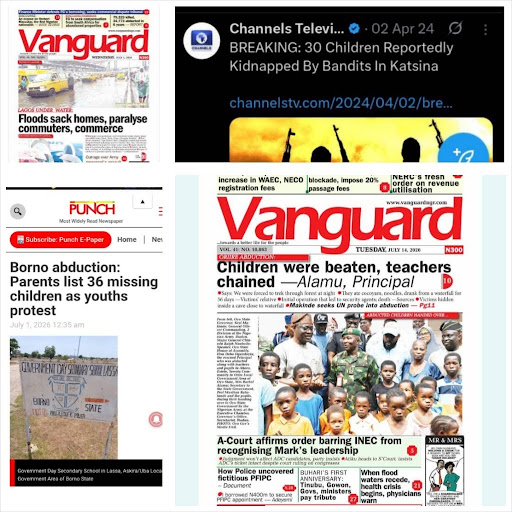
A collage of Nigerian newspaper headlines
By Similoluwa Oludayo
Years ago, while passing a popular newspaper stand in my neighbourhood in Agege, Lagos, Nigeria, I noticed a cluster of people, both old and young, staring intensely at some newspapers.
The bold fonts, long text, and urgency to read caught my attention. Then I moved closer.
“Just In: Another student abducted at …,” one headline reads.
With my jaw dropping and a slightly gloomy face, I picked another paper.
Another headline also reads, “IDP camps are overwhelmed by an increasing number of persons due to terrorist attacks.”
As I walked away, a thought raced through my heart: “Ewo ni Iróyín burúkú lárọ̀ kútù kútù?” (Why the bad news early in the morning?) I shrugged.
Then the question hit me: If Nigerian news could speak, what would it say about us?
Nigerian headlines are like the Ifa Oracle; if they could talk, they would not just report reality; they would reveal who we are, confront the norms, and give voice to the silence we have grown used to.
At times, our headlines do not bear witness to events but the patterns of silence, survival, and endurance against all odds. They sometimes reflect the tiredness of the Nigerian people. In them, we see the psychology of “another tragedy”. They are emotional indicators of a nation forced to show up daily despite an overwhelming exhaustion.
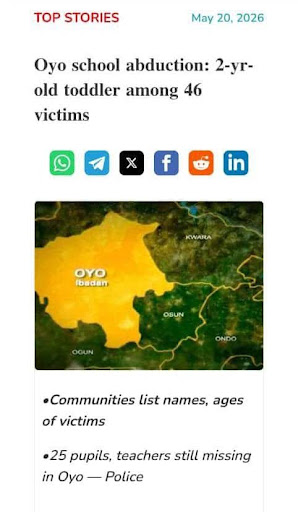
Screenshot of Vanguard newspaper’s headline of a toddler among the Oyo State school abduction
On the 15th of May, 2026, people labelled as “bandits” abducted some school pupils and teachers on duty at Oriire Local Government Area of Oyo State.

Screenshot of the X post of Oyo State Governor, Seyi Makinde, responding to protesters demanding the rescue of the abducted school children
For weeks, the narrative remained the same until recently, when the teachers and the pupils were rescued after not less than 50 days in the den of the “bandits”.
For many Nigerians, breaking news has now lost its ability to shock people because our realities have become too familiar. A flood no longer just happens; it ravages, destroys, displaces, and wreaks havoc. Yet somehow, it no longer shocks. Words like “massacre”, “disaster”, “death toll” or “ sexual molestation” begin to feel routine. The adjectives keep changing, but the public emotional response keeps dropping.

The Punch newspaper’s lead headline on the March 21, 2026, front page. Source: Punch newspaper
Perhaps the headlines repeat on purpose, to shape public perception: the same story retold again and again, each time framed a little differently.
Or maybe it is the echo chamber effect of bad news: killings in the morning, abductions by noon, and gender-based violence by evening.
These repeated failures, especially in cases like insecurity, make headlines feel inevitable rather than preventable. Patterns in these headlines reflect institutional distrust and collective fatigue from prolonged struggle.
“Residents lament rising insecurity with no help in sight…,” one headline reads.
The government will say, “We want to assure the general public that we feel their pain and send our condolences to the families of the bereaved,” or “Perpetrators will be brought to book… We will swiftly swing into action…” the authorities assure.

Screenshot of Channels TV’s headline report of Former President Buhari assuring the release of Leah Sharibu on April 13, 2019.
Years down the line, some of these girls remain in captivity, with many reportedly forced to become mothers at a young age.
Headlines like that archive political promises, keep track of vows, but fail to follow up after years of unfulfilled promises.
However, if the headline could speak, it would say, “They have used me so often to make promises. I no longer know if I mean action or routine.”
What we often forget is that behind these words are real people and real lives affected beyond what language can barely hold.
Somewhere, mothers are still waiting for daughters or sons who were meant to return home after the last school bell, who left with laughter and the promise of an ordinary day. The eyes of mothers are tired from sobbing; their arms, once open in anticipation, are now held in quiet uncertainty.
The headline that reads “abducted” cannot capture what it means to wait for a child held in captivity.
And yet our response has changed, not because we do not feel the pain but because we have learned to expect the same endings.
So we move on, not out of indifference, but out of a quiet understanding that we have seen this before and may see it again.
If the headline could talk, it would say, “I am not one story. I am the many stories repeating through different dates, different places, and different pain.”
It would add: “I am the breaking news that appears on your TV screens in the morning but disappears in the evening, as though people’s lives fade that quickly.
“I am the story of missing girls: Chibok, Dapchi, and others whose names I carry but whose endings I do not have.
“I am the headline that carries the promises from authorities. I have repeated that promise so often that I no longer know if it is action or routine.
“And still, I carry many stories, not just one, repeating through different dates, different places, and different pain.”
The headlines would say:
“We are the headlines of a country learning to live with repetition. We are the voices of insecurity, disaster, abduction, and loss, repackaged again and again as ‘breaking news.’ We are what was reported, shared, forgotten, and reported again.”
Rather than seeing headlines as merely concise summaries, they are patterns that have conditioned the public to move on too quickly, even when the issue persists.
To whom it may concern: government, authorities, policymakers, and citizens.
Do not see headlines as just information. Listen to the voices in them.
Read, not just with your eyes but with your conscience.
When headlines repeat, crises repeat.
When crises repeat, solutions fail.
Failing solutions mean something deeper is wrong.
Let us look beyond the words, connect the missing pieces and listen.
Fix the stories so that headlines do not have to keep repeating them.