

Two countries. Two apps. Two proofs that a story doesn’t need to be true to kill people.

By Saheed Ibrahim
Starting around 2017, fake WhatsApp messages began warning Indians about child kidnapping gangs operating in different communities. Some messages came with doctored videos showing what looked like real abductions. None of it was true, but the messages spread fast, and they spread differently in each town, tailored to feel local and urgent.
The result was a wave of mob killings, not from a single viral post but from dozens of separate rumours travelling through trusted networks like family groups and neighbourhood chats. A BBC investigation verified at least 31 deaths across 23 incidents in 12 states over two years, with 20 of those incidents happening in just four months in 2018. The Indian government eventually pressured WhatsApp to add features slowing down forwarded messages.
Researchers who studied the ugly development closely found something that should worry anyone who assumes technology alone is the problem. LSE’s WhatsApp Vigilantes report by Banaji et al. interviewed 275 people and found that encryption wasn’t the real driver, but existing prejudice was. People forwarded messages from senders they trusted, not because the content was credible, but because the source was familiar. Chinmayi Arun’s paper in Economic & Political Weekly makes a similar point that the rumours should be treated as incitement, not just as bad information.
Around the same period, a different platform was doing similar damage at a much larger scale. Facebook posts portraying the Rohingya minority as terrorists and invaders spread widely across Myanmar. This mattered even more because for many users in the country, Facebook wasn’t just one app among many; it was their main way of accessing the internet. Much of the content was not organic but manufactured. Reports later found that Myanmar military personnel ran fake accounts disguised as fan pages and entertainment pages, quietly spreading hateful content. The New York Times, in Paul Mozur’s 2018 investigation “A Genocide Incited on Facebook”, traced the military’s fake accounts back years before anyone acted on them
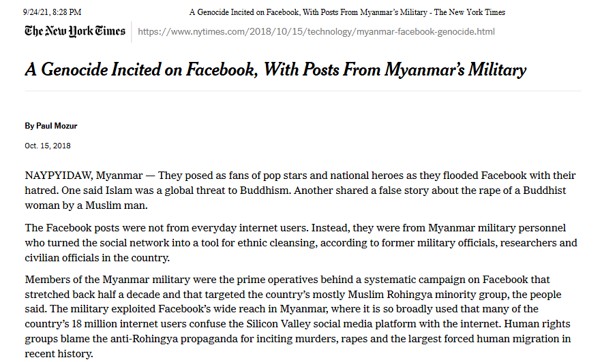
Screenshot of the New York Times’ piece.
The consequences were catastrophic. Ethnic violence escalated sharply in 2017, and more than 700,000 Rohingya fled into Bangladesh. The UN Independent International Fact-Finding Mission on Myanmar concluded that Facebook had played a significant role in spreading the hatred behind it, and separate Facebook-commissioned Human Rights Impact Assessments admitted the company did not do enough to stop the crisis.
One important lesson here is that framing beats facts. Neither of these two cases spread because people are gullible. They spread because the stories were emotionally framed in ways that resonate with the people, such as “A kidnapper on your street, an invader threatening your faith”. These are not abstract claims; they are stories with a villain, a victim, and an urgent reason to act right now.
That structure travels faster than any fact-check because fact-checks explain, while these stories move people to do something. Add a trusted sender, whether a family member or a familiar-looking fan page, and the story arrives pre-approved.
This is why simply publishing fact-checks never fully works to combat misinformation and disinformation, especially in low-resource countries and where government institutions have low credibility.
You cannot out-argue a story with a bullet point. When someone believes a fake story, hitting them with a list of corrected facts usually does not change their mind, because you are fighting an emotional “battle” with logic. The fix has to happen at the framing level too: teaching people to notice when a message is built to trigger action rather than thought, and to pause specifically at the moment they feel the urge to forward or share.
As Massimo Flore recommends in “The Immunity Illusion: Media Literacy in an Age of Identity-Driven Disinformation“, for media literacy programmes to be effective, they must address four interconnected dimensions: a) analytical processing: slow, deliberate reasoning we use to check facts and spot flaws in a claim; b) identity-protective cognition: judging information by whether it threatens your group identity rather than by whether it’s true; c) emotional responses: feelings like fear and anger that push people to share or believe before they’ve thought it through; and d) narrative persuasion: the power of a well-structured story to feel true and stick in memory, even without evidence.
None of these four works alone. They all sit inside a person’s existing web of beliefs, past experiences and trusted sources, which acts like a filter on new information. A narrative is accepted or rejected based on whether it fits what a person already believes, not on its own merits, which is why the same fact-check can land perfectly with one person and do nothing for another.
As individuals, before you forward anything urgent, ask who benefits if it spreads, and check if you are reacting to a fact or to a feeling of danger. Platforms should treat message design, not just message content, as a risk signal. Editors and creators carry real responsibility here too. If you’re building content that spreads because it triggers fear or anger, know what you’re building. Understanding how that mechanism works is the first step toward not becoming part of it. Interventions against disinformation and misinformation must prioritise community and multi-stakeholder approaches.