

Detection tools alone won’t save the 2027 elections from AI disinformation. Here’s what will
Most AI fakes reach voters through their phones. Photo: Olumide Bamgbelu / Unsplash
By Saheed Ibrahim
In April 2023, an audio clip said to be a phone call between Peter Obi, the Labour Party presidential candidate, and Bishop David Oyedepo went viral. Nigerians called it the “Yes Daddy” audio.
Was it real or AI? Fact-checkers and analysts turned to AI detection tools for the answer, and the tools could not agree.
Peoples Gazette and National Daily reported that the Foundation for Investigative Journalism (FIJ) ran the clip through Deepware and said it was neither AI-generated nor edited. PRNigeria’s fact-check also concluded that “the leaked phone conversation is to a very large extent FACTUAL.”
As reported by BusinessDay, a group called Democracy Watchman said its verification with Adobe Premiere Pro showed signs of editing, and an open-source deepfake detector flagged the audio as AI-generated. Similarly, Prime Business Africa reported that an investigation by the Centre for Democracy and Development revealed that the audio had been manipulated.
Despite saying analysis using Deepware did not detect any alterations in the audio, the International Centre for Investigative Reporting (ICIR) adds that “the effectiveness of the software is still under question.”
In the end, no machine settled the case.
We’re seeing the signs
While the 2023 elections witnessed the use of publicly available artificial intelligence (AI) tools to generate misleading content, the 2027 elections could witness a much greater scale of AI-generated disinformation. The signs are already here. Last month, INEC began investigating suspected AI-generated photographs in the preliminary voter register it published online on 26 October. The INEC chairman later blamed some of the images on registration officers who had access to register people. Deepfakes targeting candidates are circulating. And INEC itself has set up an AI unit to detect deepfakes and says it is using AI to check result records for errors before humans verify them.
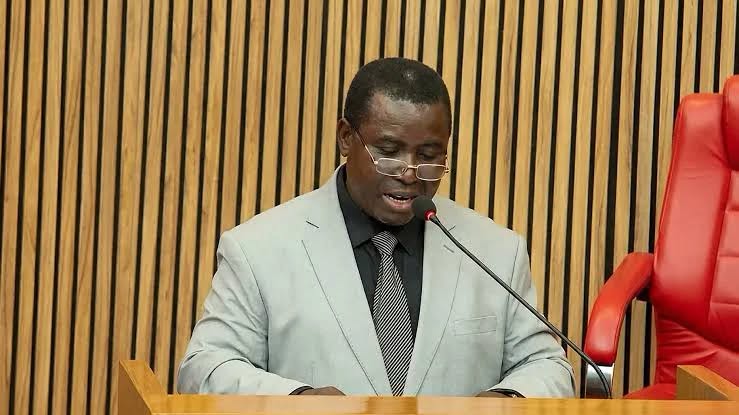
INEC Chairman, Egbetoun. Source: Punch newspaper
But here is the question: Can Nigeria effectively combat AI-generated electoral disinformation with AI?
Yes, but not with AI alone.
Why AI alone cannot win this fight
Although useful, AI tools cannot independently address the growing threat of AI-generated disinformation for several reasons.
- Faking is cheap; verification is expensive. Anyone with a smartphone can make a realistic fake image or voice note in minutes, often for free. Reliable verification tools are harder to get. Many are expensive, require technical skill or struggle with content from newer AI models. Dubawa, one of Africa’s leading fact-checking organisations, has noted that while some paid detection tools work well, many newsrooms simply cannot afford them.
- The tools do not speak our languages. Most detection tools were built and trained mainly on Western faces and English-language content. Digital rights researchers at CIPESA say these tools remain inadequate in culturally and linguistically diverse regions. Nigeria has hundreds of languages. A cloned voice note in Hausa, Yoruba, Igbo or Pidgin can slip through where an English one might be caught. A recent study identified persistent limitations in multilingual information retrieval and fact verification.
- Fact-checkers are stretched thin. Nigerian fact-checkers do important work with very few people, little money and limited tools. A fake result sheet can travel through thousands of WhatsApp groups before a single fact-check is published. The emergence of AI-generated content increases the volume and complexity of the work.
- Electoral disinformation is a social problem, not just a technical one. People do not share disinformation only because they believe it. They share it because it confirms what they already think and protects the side they belong to. No detection tool can fix that. An AI detector may identify a manipulated video, but it cannot independently address the political grievances, institutional distrust and social divisions that make such content believable.
In a twist, politicians now use AI as an excuse. According to WITNESS, about a third of the cases sent to its deepfake response team in 2024 involved politicians claiming that genuine content was AI-generated. When anything can be fake, the truth also becomes easy to deny.
Where the danger really lies
My recommendations rest on four points.
First, the most dangerous deepfakes target the process, not just the candidates. My recent research findings show that the deepfakes that do the most harm in Nigeria are those aimed at the electoral process, especially vote counting and results. We saw a version of this in 2023, when results stopped appearing on IReV and INEC was slow to explain. That silence was filled with rumours. INEC’s chairman has himself listed the kinds of attacks to expect in 2027: fake videos of electoral officials announcing false results, cloned audio of Resident Electoral Commissioners, forged letters postponing elections and doctored result sheets shared right after voting.
Second, the people who share fakes will not stop. Politicians, their supporters and paid actors have tasted the power of deepfakes and disinformation. They will not let go, not even in this cycle. Confirmation bias and identity protection sit at the centre of political communication in Nigeria.
Third, INEC has a credibility problem. How the commission was set up, how its leaders are appointed and how it operates are all points of concern for many Nigerians. When people already doubt an institution, they are more ready to believe lies about it.
Fourth, more than half of Nigerians are offline. DataReportal estimates that 52.5 per cent of Nigerians, about 128 million people, were not using the internet by late 2026. Any plan that lives only online leaves most voters out.
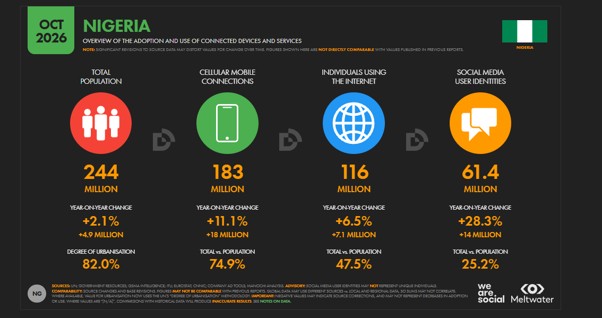
About 116 million of Nigeria’s 244 million people are online. More than half are not.
Source: DataReportal / We Are Social and Meltwater, October 2026
So what do we do?
- INEC must earn trust before election day. Trust is not demanded. It is earned. INEC needs to show accountability and transparency in how it works, not just talk about it. Give Nigerians the confidence they seek, and stick to it on election day and after.
- Institutions must work together. INEC cannot fight this battle alone. There must be a coordinated arrangement involving the National Orientation Agency (NOA), the Nigerian Communications Commission (NCC), media organisations, fact-checking organisations and relevant civil society groups. The goal is to share credible information quickly, correct false claims and keep Nigerians updated throughout the electoral process. One practical step is SMS alerts. Working with telecom operators, INEC can send verified updates to registered voters on polling arrangements, voting procedures and other key information. This reaches people who rarely use social media or the internet.
- INEC needs an Information Integrity Desk. This is a key recommendation from my research. The desk would be INEC’s in-house fact-checking arm, staffed with OSINT and IT experts and other professionals who understand information integrity and human rights. It would give regular updates, work directly with fact-checkers and media houses, make credible information available at all times and correct manipulated content fast. When the next IReV glitch happens, Nigerians should hear from this desk within the hour, not days later.
- The media must step up. INEC should open clear channels with credible media houses and fact-checkers, giving them verifiable information and quick responses to emerging claims. But the responsibility is not INEC’s alone. Media organisations must strengthen their verification, avoid amplifying unverified content and put accuracy before the rush to publish first.
- Take the fight beyond the internet. With most Nigerians offline, radio becomes the way to go. Radio reaches millions of Nigerians and remains a major source of election information for many households. Imagine radio stations joining the fight by debunking electoral falsehoods in their programmes and news bulletins, in local languages. Imagine newspapers running a regular column that corrects viral disinformation. That is how our traditional media can come in.
- Prebunk before you debunk. It is easier to protect people before a lie reaches them than to correct them after. Before election day, INEC and its partners should explain in simple terms how results move from the polling unit to collation, what a genuine result sheet looks like, and how INEC will and will not announce changes. If voters know INEC will never postpone an election through a WhatsApp voice note, that fake voice note loses its power.
- Use trusted voices in the community. My recent research with colleagues shows that more political claims travel via offline channels than on the internet. Religious leaders, traditional rulers, market and transport unions and community groups are trusted in ways institutions are not. Bring them into the information plan, especially for offline communities.
- Hold the platforms to account. Meta, TikTok, X and WhatsApp must act faster on Nigerian content and invest in local language moderation. African users and fact-checkers have long complained of slower takedowns and tools that do not understand our languages or our politics. INEC and relevant stakeholders should establish clear escalation channels with platforms for reporting high-impact electoral disinformation, impersonation and coordinated inauthentic behaviour. Platforms should also be more open about political advertising, synthetic media and coordinated networks trying to manipulate opinion. The aim is timely action, not censorship of legitimate criticism.
Conclusion
So, should we use AI to fight AI? Yes, but only as a tool in steady hands. AI can help the Information Integrity Desk and fact-checkers monitor what is spreading, spot patterns and decide what to check first. The final call must stay with people. INEC has said as much: it will not hand critical electoral decisions over to automated systems.
The Yes Daddy audio taught us that a detection tool is only as useful as the trust people have in the verdict and in those who deliver it. AI deepfakes will still be shared in the 2027 elections. We cannot stop that. Addressing it needs more than detection tools. It needs an electoral institution that communicates transparently, a media ecosystem that takes its verification responsibilities seriously, fact-checkers with the resources to do their work and a public that has access to credible information, both online and offline.
We may not be able to stop every AI-generated image, cloned voice or manipulated video from being created and shared. But we can reduce their ability to deceive, gain traction and influence electoral decisions.