
Combating misinformation requires more than fact-checkers and occasional workshops. It requires embedding media and digital literacy into Nigeria’s education system from an early age, just as countries like Finland have done.
By Saheed Ibrahim
I wrote my first fake story at age 9
Yes, you read that correctly.
I wrote my first fake story at age 9, in Primary 4, and I wrote several more before I turned 18.
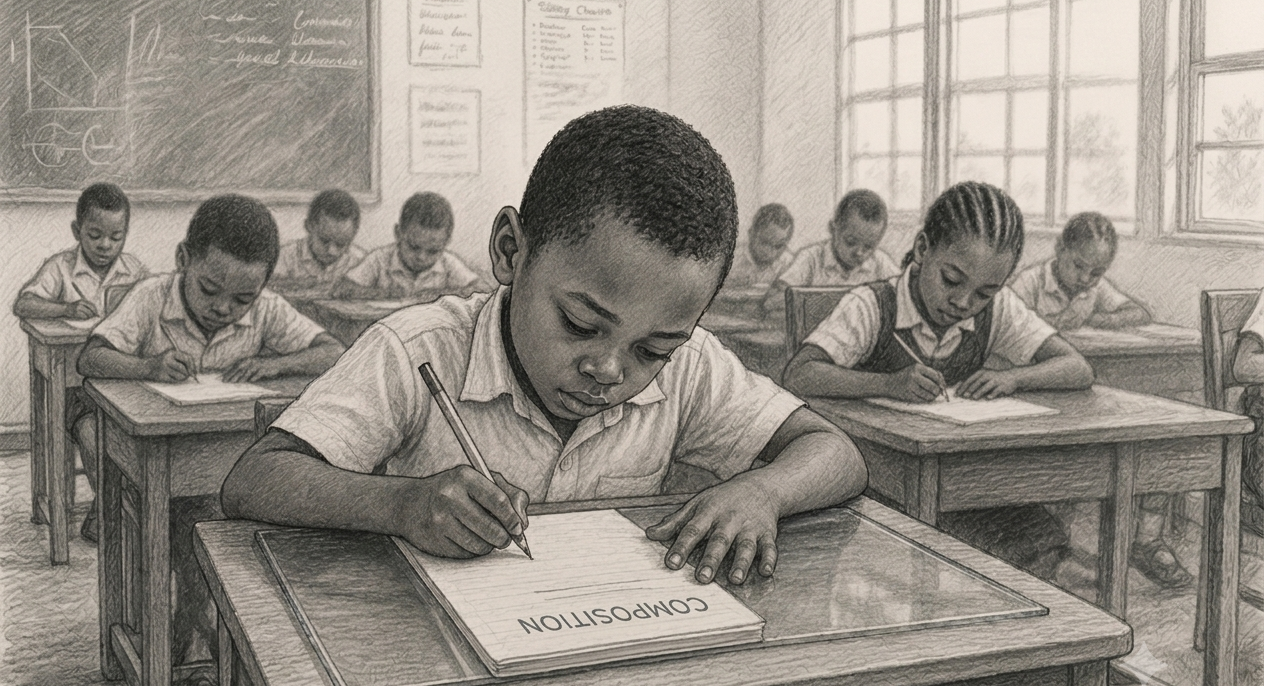
If you passed through the Nigerian basic education system, you’ll be familiar with composition writing.
Composition is meant to teach essay writing at a basic level. We moved beyond describing things, usually animals or objects, into creative writing.
I remember the first question vividly:
“Write a letter to your friend in Lagos telling him how you spent your last holiday.”
‘Holiday’ in this context means the seven-week session break, what people in the Global North call ‘summer break’.
My first problem was that I had no friend in Lagos, not even in any of the neighbouring towns. Second, I hadn’t spent my holiday doing anything interesting, other than doing chores and playing with my siblings and neighbours.
As a child, you don’t want to ‘lose face’ among your friends because we always spoke about how interesting we wanted our ‘long holiday’ to be. So, I had to write something interesting.
In my head, I travelled to Kano to meet my uncle, who doesn’t exist, and visited a zoo (if it even exists), an amusement park, and the cinema. Mind you, I had never been to Kano. I still haven’t, till today.
Right up until my senior secondary school certificate examinations, I kept writing stories like this.
It actually got better in senior secondary school, when we could choose to write stories instead of letters or argumentative essays. I always went for stories.
You’d get questions like the following:
Write a story ending with the statement ‘Indeed, it was the biggest lesson of my life.’
Or
Had I known, I wouldn’t have believed him.
The real events in my life before those exams were never strong enough to earn me the marks I wanted. So I got creative every time, using my imagination to build fictional stories.
Our English teachers didn’t just teach us how to write grammatically correct stories. They taught us how to weave emotions into them.
This is the Nigerian education system. As my friend once joked, “Little wonder we seem to have more content creators than audience.”
No doubt, this system taught us creativity and helped our cognitive development. But it also sharpened our ability to produce misinformation, popularly called fake news.
Combating the spread of misinformation in Nigeria requires more than technical fixes. We must treat it as a social process and respond with the right kind of measures, and education has a big role to play here.
For instance, Finland is making media literacy a core part of its education system, teaching citizens to spot misinformation from as early as age 3.
The Nigerian education system should take a cue from this. If I could learn to write compositions, some fictional, before I turned 10, there’s no reason the same system can’t teach children to spot misinformation during their formative years.
Independent fact-checking organisations have carried the weight of building media literacy among Nigerian students, media practitioners, civil society groups, and others, mostly through ad hoc workshops. Credit is due to them, especially since they rely on donor funding and work with limited capacity.
Still, the lasting solution is to build media and digital literacy into every level of the Nigerian education system, not leave it to occasional workshops.
In a co-authored study presented at the International Conference “Revisiting Disinformation: Critical Media Literacy Approaches”, we looked at how well journalism students in Nigeria are actually being prepared to fact-check information, and the results back up everything I’ve said so far.
We found that students who attended fact-checking workshops only had a moderate level of exposure to fact-checking training, mostly because that training came from external organisations rather than from their schools. This lines up with what other researchers have said before: that fact-checking and digital literacy should be built into the school curriculum itself.
We also found that students were fairly good with basic tools for verifying information but weak when it came to more advanced verification techniques, the kind needed to catch sophisticated misinformation. Other studies have found the same gap. One even found that over 70 per cent of student journalists know they need better digital skills; they just aren’t getting them.
Perhaps the most telling part of our findings is that even when students attended workshops, they received little to no support from their own institutions or lecturers.
The biggest obstacles were lecturers who lack fact-checking skills, a curriculum that didn’t include fact-checking, and a general lack of institutional support.
Workshops from independent fact-checking organisations have helped, but they can only take students to a moderate level. Without a proper curriculum, that’s where it stops.
Based on findings, we recommend a train-the-trainer programme for journalism lecturers so they can keep improving their own skills and pass that on to students, rather than relying only on external organisations.
Second, a proper partnership between universities and independent fact-checking organisations, with the National Universities Commission involved, to build fact-checking modules directly into the curriculum. This partnership will also enable co-teaching of media and digital literacy in schools and expose the students to sustained fact-checking work experience through internships and industrial training programmes.
The universities cannot carry this responsibility alone. Basic and secondary schools must also play their part, and this can start with something as simple as the composition and English classes I described earlier.
If pupils can be taught to write a letter or a story at age nine, they can also be taught, at that same age, to ask simple questions about what they read or watch. Questions like ‘Who wrote this?’, ‘Why did they write it, and is there proof behind it?
The Universal Basic Education Commission and the Ministry of Education can work with fact-checking organisations to build simple media literacy lessons into subjects like English Language, Civic Education and Social Studies, instead of treating it as something extra.
Teachers at this level need basic training on how to spot common misinformation patterns and how to pass that on to their pupils in a way children can understand. This is exactly the approach Finland has taken, starting media literacy from basic schools, long before students get to university.
If Nigeria adopts something similar, the fight against misinformation will not be starting late with adults who have already formed bad habits online. It will be starting early, with children who are just beginning to understand the world around them.
If Nigeria wants to seriously reduce the spread of misinformation, it has to start from the classroom, the same way it once taught me, and thousands of other children, how to write good stories and fake ones.