

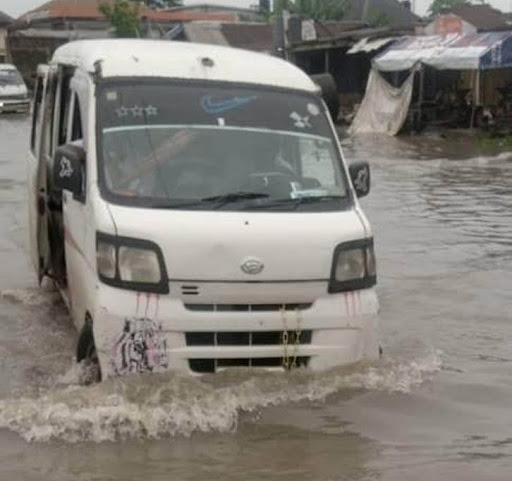
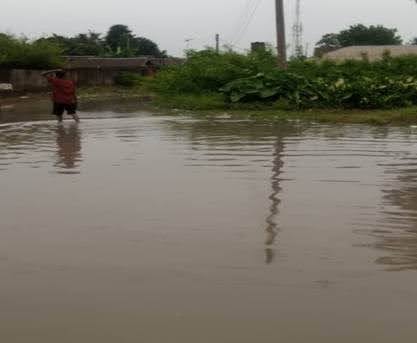
Image of a flooded road along Mbano Camp Junction. Photo credit: Ifeyinwa Susan
By Ifeyinwa Francis
For residents of Oyigbo Local Government Area in Rivers State, home has become a place of fear. Incessant flooding, worsened by collapsed drainage systems, has reduced once-stable buildings to rubble and mud.
Many buildings, once the pride of the communities, are either on the verge of collapse or have been destroyed.
Residents live in fear, grappling with recurring floods and an acute absence of government intervention.
This predicament persists despite billions of naira allocated to the Federal Government’s Ecological Fund — money meant to cushion communities like Oyigbo from environmental disasters. Instead, the funds appear to have done little to protect residents still at the mercy of raging floodwaters.
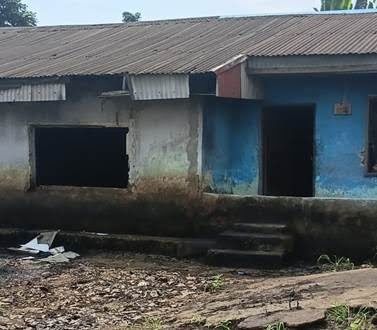
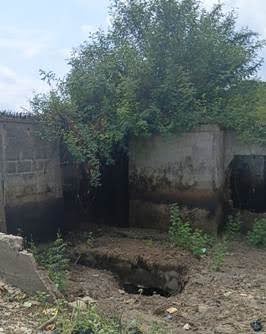
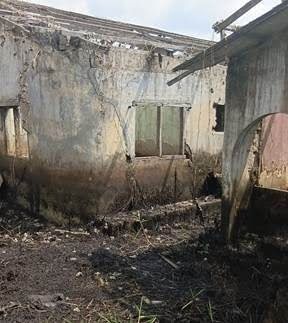
Some buildings destroyed by the 2017 flood remain in ruins. Photo credit: Ifeyinwa
Mrs Ifunanya Francis and her family were among the victims of the 2017 flood disaster that devastated Mbano Camp in Oyigbo, Rivers State. The flood, which broke through their fences, entered homes unannounced and submerged many buildings in the community.
Nine years on, nothing has changed.
Speaking to our reporter, Mrs Francis said everyone in her compound lost everything when the floodwaters submerged their buildings. Nothing in its path was spared.
“It was a miracle that we survived,” she added.
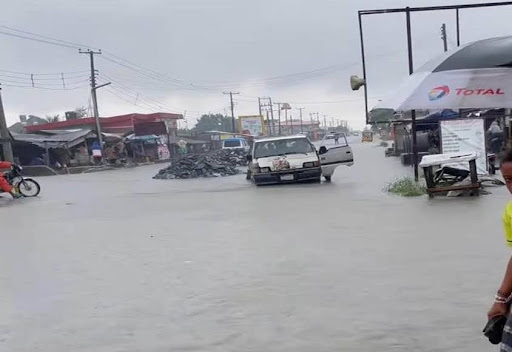
Image of Mbano Camp junction as at June 12, 2026 after a heavy rain. Photo credit: Ifeyinwa
The flood left a watermark of ruins, losses, and devastation in every home it visited, and many are yet to recover as another flooding disaster looms.
Mrs Francis said the community had long appealed to the government to build drainage channels across their streets, as heavy rainfall routinely turns the area into a swamp. These appeals had, however, been consistently ignored.
Mrs Francis added that heavy rainfall had turned the streets into muddy swamps, often accompanied by dark leeches, which forced residents to wade through unsafe floodwater.
She mentioned that a young boy named Chimezie, a resident of Mbano Camp, earned money by carrying people across difficult sections of the mud.
Mrs Francis explained that the community members had sought government intervention through various means, such as religious leaders and social media campaigns, but authorities had turned a deaf ear to their plight.
As the problem persists, the residents face widespread displacement, property destruction, public health risks, and economic paralysis.
The situation had worsened, leaving internal roads in a deplorable condition, said Mrs Ogechi Oriaku, another businesswoman in Oyigbo.
“The roads are now dilapidated, especially the road by Mbano Camp Junction. Motorists, trailers, and Keke buses that take that road sink and tumble,” she decried, adding that pedestrians also find it difficult to ply the road whenever it rains.
Though efforts were made to put the road in good shape, the problem is beyond their communal capacity to solve. “We poured stones on the road, but we still sank.”
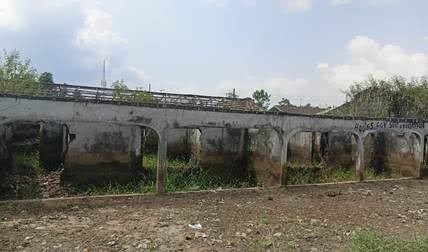
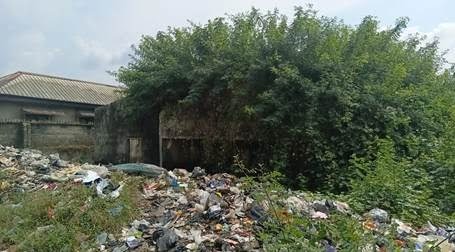
Abandoned buildings destroyed by a flash flood in Mbano Camp, Oyigbo. Photo credit: Ifeyinwa
Mud, leeches, and abandoned shops
A visit to the affected areas by the reporter revealed little to no improvement to the community.
Flood-damaged buildings remain weak and waterlogged, many filled with mud. Some houses have sunk into the ground, while others are barely recognisable, identifiable only by their zinc roofs. Over the years, impassable roads have led to the abandonment of property, shops, and buildings.
The reporter spoke with residents who attributed road deterioration to recurring flash floods. They described drainage infrastructure as non-functional and in urgent need of reconstruction.
According to them, vehicles sometimes tumble on the road, while trailers frequently get stuck in the mud. They added that during rainfall, the road becomes largely impassable, particularly for motorcycles and bicycles.

Photo of Mrs Ifunanya
One of the residents, Mrs Ifunanya Oriaku, said that the real problem lies in the poor drainage structures, bad roads, and the destruction of buildings and property caused by this flood. According to her, there was a need for road and drainage reconstructions, adding that the problem was beyond flood relief.
A shop owner, who requested anonymity, said heavy rainfall leads to flash flooding that submerges roads and residential compounds.
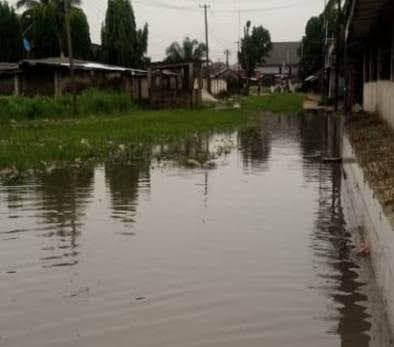
Images of streets in Mbano Camp by Ifeyinwa Susan
“This makes it impossible for us to sell. We will wait until the flood water dries up before opening our shops because the flood also covers the front of our shops.”
Another resident, Mr Uma Njoku, said heavy flooding severely restricts movement. “Even if we open our shops, there will be low customer turnout,” he added.
“We will have to swim in the mud to go out during the rainy season,” a landlady, who requested anonymity, said.
Attributing the recurring floods primarily to heavy rainfall, another Oyigbo resident, Lisa Francis, stressed that the lack of functional drainage systems further compounds the problem.

Oyigbo resident, Lisa
In an earlier report, the Chairman of the Oyigbo LGA Flood Prevention and Management Committee, Dr Victor Okpute, said that many areas of Oyigbo are prone to flash flooding due to overflow from the Imo River and heavy rainfall.
Roads swallowed by floods
Commuters have also decried the impact of persistent flooding, calling on the government to prioritise the construction of drainage systems and implement flood and erosion control projects, particularly in Oyigbo, identified as one of the most flood-prone areas.
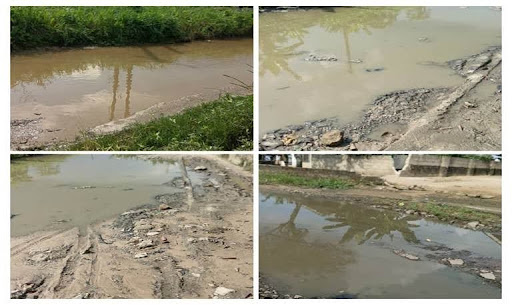
Images of Imo Street, Oyigbo. Photo credit: Ifeyinwa
According to them, the Mbano Camp Junction along the Port Harcourt–Aba road is in a particularly poor state, which they have repeatedly complained about.
The road serves as a major link between Port Harcourt in Rivers State and Aba in Abia State. From Mbano Camp Junction, the road stretches westward to Port Harcourt and eastward to Aba and beyond.
A hawker, Grace Matthew, complained bitterly about how this flooding has equally affected roads and businesses, especially in Imo Street, her residential area.
She said that whenever it rains, it becomes impossible for her to hawk, unless the flood subsides after a few days. She said that slows down her business.
A motorcyclist, Mr Luke Chimezie, said that the route damaged by flash floods has been abandoned as an access road. Drivers now take a different route that is at least 5 kilometres farther.
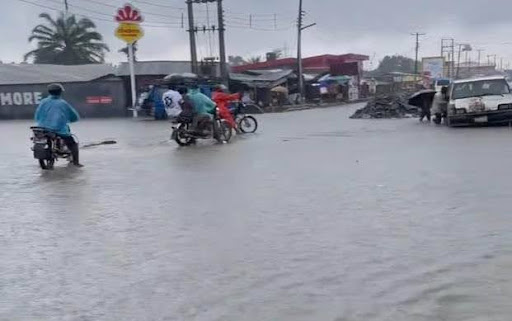
Image of Mbano Camp junction captured after heavy rain. Credit: Ifeyinwa
Despite projects worth billions of naira earmarked for emergency road construction in flood-affected communities within Oyigbo LGA, several roads used by hundreds of residents remain inaccessible and continue to deteriorate.
Billions approved, contractor gone.
The Oyigbo–Afam Road remains a critical access route connecting Oyigbo and Afam, underscoring the road’s impact on economic activities.
In late 2021, the Rivers State Executive Council, under then Governor Nyesom Wike, approved a ₦25 billion loan from Zenith Bank to fund key infrastructure projects, including the Oyigbo–Afam Road. The loan was to be repaid from the state’s internally generated revenue. The contract was awarded to Lubrik Construction Company.
Following Rivers State’s placement on red alert by the Nigeria Hydrological Services Agency (NIHSA), the then-Governor Nyesom Wike set up flood response systems across several local government areas, including Degema, Onelga, Obio Akpor, Abua/Odual, Ahoada East, Ahoada West, Akuku Toru, Gokana, Opobo, Port Harcourt City, Bonny, Oyigbo and Etche.
Additionally, the state government, through its Flood Management and Prevention Committee, distributed relief materials to flood victims in Oyigbo Local Government Area on 19 November 2025.
Despite these efforts, the Oyigbo–Afam Road continues to deteriorate significantly whenever it rains. While parts of the road were reconstructed, residents said large sections remained incomplete as far back as 2020/2021, with communities still appealing to contractors to return to the site.
600 dead, 1.3 million displaced
More than 600 people have died in the worst flooding Nigeria has seen in a decade; 1.3 million people have been displaced, and more than 200,000 homes have been destroyed. A report by the United Nations shows that floods have impacted more than 2.8 million people, causing hundreds of deaths across Nigeria.
Several reports by the National Emergency Management Agency (NEMA) show that floods affected 134,435 people across 20 states and 47 local government areas, including Rivers State. The agency reported that no fewer than 165 persons died and 82 were reported missing between January and December 2025.
In October 2025, Rivers State was listed among the 10 most affected states on NEMA’s flood dashboard, alongside Lagos, Adamawa, Akwa Ibom, Imo, Taraba, Delta, Abia, Borno, and Kaduna.
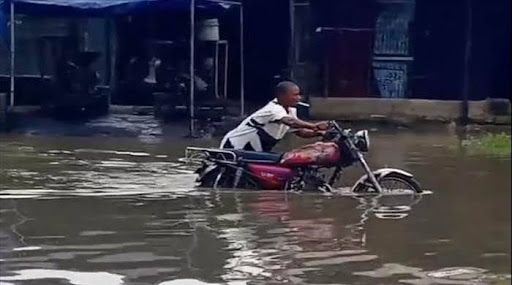
Image of Mbano Camp junction along the Ph/Aba road. Photo credit: Ifeyinwa Susan
N1 trillion allocated, communities still underwater
According to Vanguard, roughly N1 trillion, representing 2.2 per cent of the total budgets for 2018, 2019 and 2023, was allocated to ecological and disaster management by the federal government.
In June 2022, the Nigerian House of Representatives alleged mismanagement of the fund and mandated its Committee on Environment to investigate remittances to the Ecological Fund and withdrawals between 2010 and 2022.
The Ecological Fund is a special intervention fund established by the Federal Government to tackle environmental and ecological problems affecting communities across Nigeria. It was initially funded with one per cent of the Federation Account, increased to two per cent in 1992, and later strengthened with an additional one per cent from the derivation allocation, bringing the total allocation to three per cent.
The presidency challenged states to account for how the N1 trillion from the Ecological Fund was spent in addressing floods and other environmental challenges.
The Nigerian government and the Niger Delta Development Commission (NDDC) completed the reconstruction of 7.3km Oyigbo Road Network (Obunku-Umuosi-Obeakpu-Mgboji-Ndoki Road) and commissioned it on February 26, 2026, by the Honourable Minister of Regional Development, Abubakar Momoh.
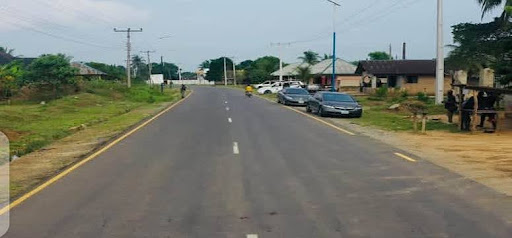
Commissioned 7.3km Oyigbo Road Network. Source: Dr Samuel Ogbuku’s Instagram page
However, Luke Chimezie said the government only constructed major road networks while internal and rural roads remain in a deplorable condition.
Zero accountability, failed contract
Public records on Eyemark indicate that a drainage project in Umuagbai Community, Oyigbo LGA, Rivers State, was approved with an allocation of ₦20 million in the 2023 budget under the Federal Ministry of Water Resources.
Eyemark is a national monitoring and evaluation app launched by the Nigerian government in December 2022 to enable citizens to track, review, and report on federal capital projects.
However, as of November 2024, the project was still listed as “NOT STARTED”, with no public updates on its execution.
Another report revealed that the 36 states and 774 local government areas shared a total of N94.62bn from the Ecological Fund between January and September 2025.
According to The Cable, data from the National Bureau of Statistics shows that between January and May 2025, the 36 states received N22.90 billion as ecological funds from the Federation Account Allocation Committee (FAAC). Within this period, Rivers State received N437,368,743.17.
As of the time of filing this report, there is no clear public record detailing how trillions of naira earmarked for ecological and disaster management have been spent in Rivers State.
While the federal government has raised concerns over alleged mismanagement, the state government has not provided verifiable documentation on how the funds were utilised.
The Federal Government awarded a contract for the 43-kilometre Port Harcourt–Aba highway to the China Civil Engineering Construction Corporation. However, the contract was terminated in late 2025 over poor performance.
Despite increasing disbursements, the country continues to experience worsening flood incidents.
Ministry blames geography, offers no timeline
The reporter reached out to the Rivers State Ministry of Works to ascertain what steps had been taken to address the flooding in Oyigbo and its impact on roads, including the Port Harcourt–Aba highway near Mbano Camp Junction.
Engineer Braide Allwell, who represented the Ministry, explained that the real cause of flooding in Oyigbo, especially around Mbano Camp, is the land’s flat topography (terrain).
When asked about the efforts the state is making to combat the environmental challenge, he said, “So far, the effort we are trying to make is to construct a storm drainage that will take water from Mbano Road and its surroundings straight to the Imo River.”
Allwell added that the state government had integrated drainage systems into road construction, but human activities, such as poor waste management and lack of maintenance, have left the drainage systems in a deplorable state.
He noted that the lack of enabling laws to enforce maintenance and punish the offenders often results in flooding-prone roads.
He could not provide data on the amount of money the state has spent on repairing these flood-damaged roads in Oyigbo, as well as a timeline for the ongoing or proposed intervention in the area.
FOI request ignored
In line with the provisions of Sections 1, 2, and 3 of the Freedom of Information (FOI) Act, 2011, the journalist physically submitted an FOI request to the Rivers State Ministry of Environment on January 15, 2026, at the Rivers State Secretariat Complex in Port Harcourt.
The ministry acknowledged receipt of the request on the same day by signing and stamping the document.
An official at the ministry advised that the request should be directed to the Rivers State Permanent Secretary. Consequently, an email containing the FOI request was sent to the state secretariat at the Podium Block, 2nd Floor, Rivers State Secretariat Complex, Moscow Road, Port Harcourt.
The FOI request sought details of the disbursement of the federal government’s ecological fund within the state, including the total amount received by Rivers State.
It also requested a breakdown of disbursements to all local government areas, including the specific allocation to Oyigbo LGA.
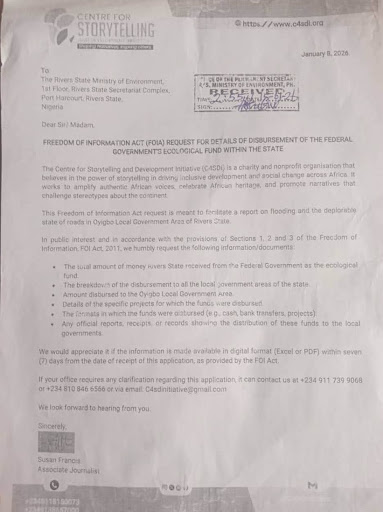
Copy of the FOIA request delivered to the Rivers State Ministry of Environment
Further details requested included the specific projects funded, as well as the modes of disbursement, whether through cash, bank transfers or project execution.
Under the FOI Act, the ministry is required to respond within seven days of receiving such a request, making the deadline January 22, 2026.
As of the time of publication, neither the ministry nor the state secretariat had responded.
Environmental experts suggest solutions
Speaking on the impact of flooding and possible remedies, the Executive Director of the Securecycle Environmental and Climate Change Initiative, Emmanuel Kilaso, said flooding in Nigeria has shifted from a seasonal nuisance to a systemic threat.

Emmanuel Kilaso
“We are witnessing the devastating collision of climate change, decaying infrastructure, and rapid, unplanned urbanisation.”
Emmanuel highlighted massive groundwater contamination from sewage/industrial runoff and the permanent loss of vital topsoil across the Niger Basin as some of the environmental damage from flooding.
While enumerating some mitigation strategies, Emmanuel emphasised the protection of wetlands and mangroves to act as natural sponges for excess runoff, to end the plastic-choked drainage crisis through circular economy initiatives and strict enforcement of anti-dumping laws.
He pointed out the need for an infrastructure audit, immediate desilting of urban drains and structural reinforcement of vulnerable dams, such as the Alau Dam.
He further suggested that the Early Warning Systems (EWS) must be localised into indigenous languages and delivered via community radio.

Blessing Ekwere
An environmental sustainability advocate and climate change expert, Blessing Ekwere, told CSDI that flash flooding poses serious environmental, economic, and public health threats to communities across Rivers State, particularly because the state is naturally riverine and highly vulnerable to rising water levels during the intense rainfall periods.
“Southern Nigeria, including Rivers State, is richly endowed with diverse plant and animal species. The region’s aquatic ecosystem alone supports over 270 species of fish, many of which sustain local livelihoods and food systems.”
She pointed out that the environmental challenge has direct economic implications for local communities. “Many residents of Rivers State rely on fishing and farming for survival. Flooding destroys farmlands, contaminates rivers, reduces fish populations, and disrupts businesses, transportation, markets, and daily work activities across the state.”
Ekwere also noted the impact of flash flooding on public health. She claimed that during flooding, these pollutants can spread rapidly into residential areas, exposing communities to additional environmental and health hazards. Consequently, she added that beyond the immediate loss of lives and property during flood events, there is also the risk of long-term illness and deaths arising from environmental contamination if urgent interventions are not implemented.
The environmental expert further enumerated some measures that can help reduce the impact of flooding on communities.
“First, there is an urgent need for the construction and maintenance of effective drainage systems capable of safely channelling excess water during peak rainy seasons. In addition, early warning systems and community preparedness are essential.
Finally, addressing flash flooding in Rivers State requires a combination of government intervention, urban planning, and active community participation,” she said.